
Inflation, affordability, and the AI backlash
Welcome to Cautious Optimism, a newsletter on tech, business and power. Modestly upbeat.
Tuesday! This is the last edition of CO for a few days. Spouse and I are scheduled to welcome our third child into the world tomorrow, so I won’t be around to write up the newsletter. Pending all goes to plan, CO will return in the mornings some time next week after we sort out our new family schedule. I’m stoked!
Before I head out into the newborn realm, however, I’m chatting with my friend Leslie Feinzaig on a Substack Live (her blog can be found here) later today. If you want to hear the general partner of Graham & Walker and I chat about venture capital, technology, and life, come hang at 3:30 Eastern Time today. To work! — Alex
📈 Trending Up: Central bank solidarity … Iranian bravery … self-driving in New York … domestic compute capacity … ElevenLabs … Apple-Google AI ties … Apple, the software company? … AI investments in health … Deepgram …
Read This: Crunchbase News’s Mary Ann Azevedo reports that “Latin American startup investment climbed by 14.3% in 2025.”
📉 Trending Down: Working at Meta … American AI dominance? … working at BlackRock … the DoJ … deficits in Israel …
Things That Matter
Apple + Google = Unfair? News that Google won the Apple AI bakeoff is big news. A blow to OpenAI and Anthropic, presumably, but that’s not who is making annoyed comments about the choice. Instead, the CEO of xAI is irked, saying in a post that the combination “seems like an unreasonable concentration of power for Google, given that [they] also have Android and Chrome.”
The point is reasonable: Google will now control native distribution channels for its AI products (its browser, its mobile operating system, etc), while also enjoying status as the AI provider of choice for the other major mobile OS.
If you are xAI, working to garner attention and dollar share in a competitive market, competing not only on the merits of your technology is tough enough. Fighting private rivals while also fighting uphill against industry goliaths playing nice with one another is enough to make anyone agitate for a little antitrust enforcement.
Inflation, affordability, and the AI backlash: In a new post on Truth Social ($TMTG, the fusion company), POTUS said that utility bills are rising, intimating in the same missive that data centers are to blame. Microsoft, Trump wrote, will now work to ensure that its data centers don’t cost consumers:
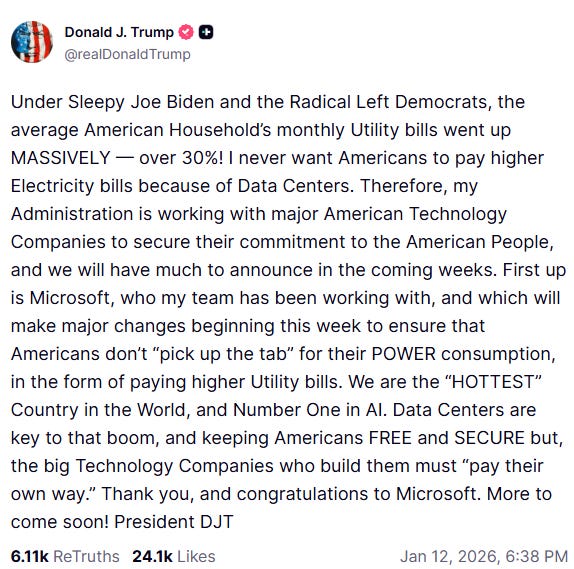
What’s all this about? Mostly the midterm elections. POTUS is earning poor marks from American voters for his handling of the economy (polling average), and even worse grades on his handling of inflation (polling average).
Looking at today’s inflation data, a few numbers stood out:
Energy Services inflation: +7.4% (unadjusted, twelve months ending December 2025)
Electricity (subset of Energy Services): +6.7% (unadjusted, twelve months ending December 2025)
Utility (piped) gas service (subset of Energy Services): +10.8% (unadjusted, twelve months ending December 2025)
If you are getting hammered on affordability after promising to lower prices as those same prices rise, you start looking for levers. Hence, PTOUS aping the Sanders-wing of the Democractic party to artificially cap credit card interest rates, and blocking certain companies from buying single-family homes.
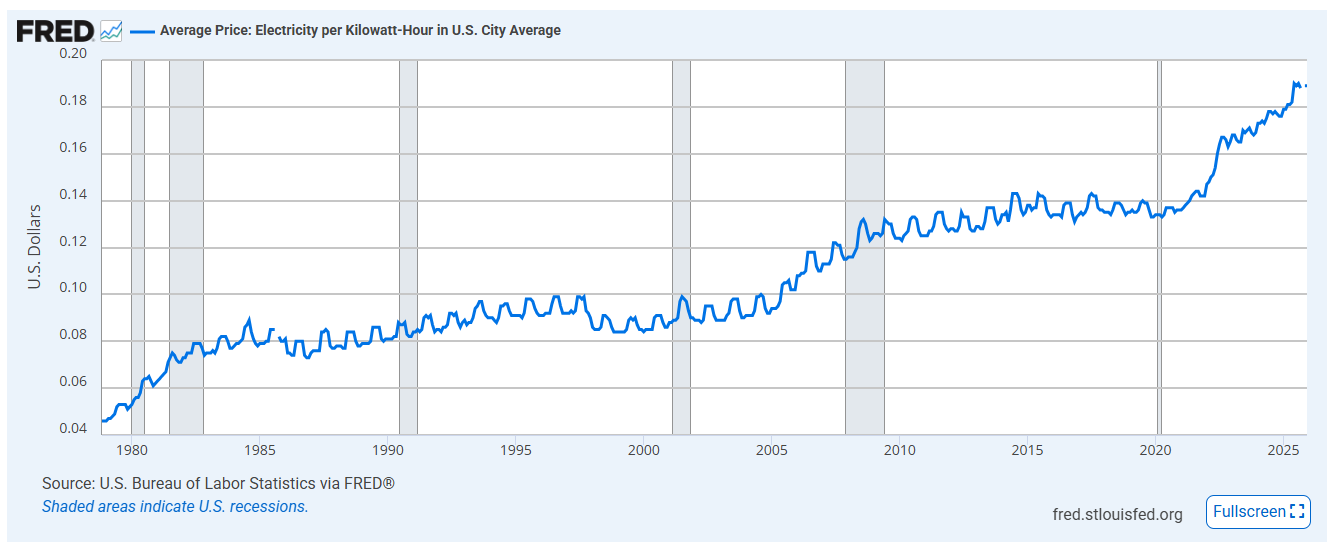
And, now, taking tech to task for the cost of adding gigawatts worth of power demand to the national grid. Precisely how much of an impact you think that data centers are having on consumer power prices will vary based on your politics, but I do find the following chart to be food for thought (Average Price: Electricity per Kilowatt-Hour in U.S. City Average, via FRED):
So, what has Microsoft committed to, in terms of lowering the potential consumer-price impact of plugging in gigawatts worth of new compute? Let’s hear from the company, describing its “Community-First AI Infrastructure” plan:
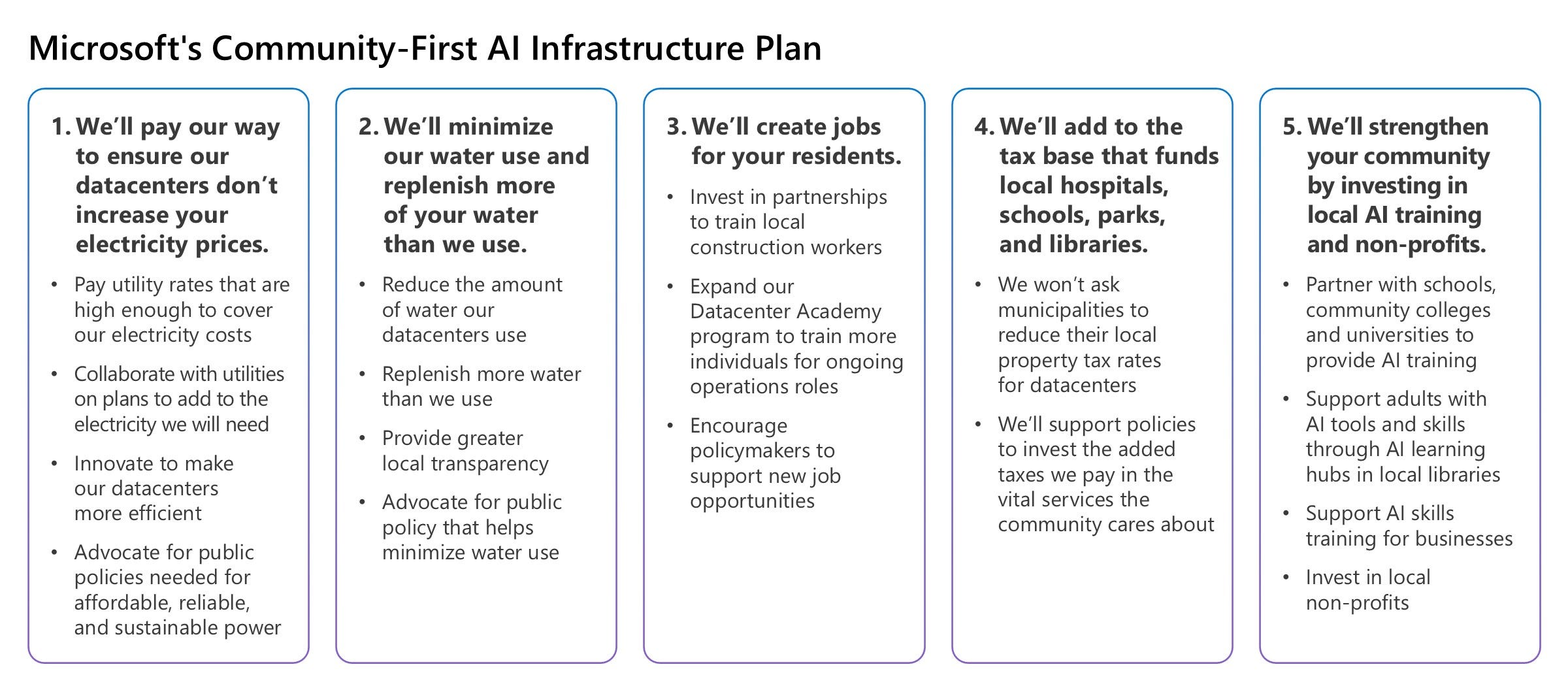
On the first point, Microsoft writes that it intends to “ask utilities and public commissions to set [its] rates high enough to cover the electricity costs for [its] datacenters,” including “the costs of adding and using the electricity infrastructure needed for the datacenters [the company] build[s], own[s], and operate[s].” Redmond also intends to work “with local utilities to add electricity and the supporting infrastructure to the grid when needed for [its] datacenters.”
On the jobs front, Microsoft intends to help train local workers to “support the construction and maintenance of datacenters” while also expanding its “Datacenter Academy program to train individuals to fill ongoing datacenter operations roles.
Finally, picking from a long list of plans, Microsoft writes that it will not “ask local municipalities to reduce their local property tax rates when [it] buy[s] land or propose[s] a datacenter presence,” instead opting to “pay [its] full and fair share of local property taxes, adding revenue to local towns and cities.”
People forget that Microsoft is a company with progressive roots. It was early on supporting gay marriage (more on LGBTQ support at Microsoft from the archives), for example. And back when I was a beat reporter covering the company, I heard several stories from its workers about how Microsoft was a place where folks existing outside old-fashioned social norms could find a home.
To see Microsoft pledge to use its incredible wealth to limit the price impact of its AI buildout, while working to ensure that local communities benefit from new jobs created and undertaking efforts to lower its power and water demands, is praiseworthy. Well done. This is what leadership looks like. Ten points to Redmond.
How much power are we talking about? In its most recent earnings call, Microsoft said that its planned data center in Fairwater, Wisconsin (“the world’s most powerful AI datacenter”) will scale to two gigawatts on its own. For reference, that’s just under the entire power-generating capacity of Rhode Island (summer conditions).
Claude Cowork
A few days ago, we wrote that Claude Code was impressive not only due to its ability to write a lot of code quickly and intelligently. Instead, savvy AI users were putting Claude Code to work on a host of other tasks, including organizing their lives.
Anthropic seems to have noticed, announcing Claude Cowork this week. Here’s how Dario and friends describe the product:
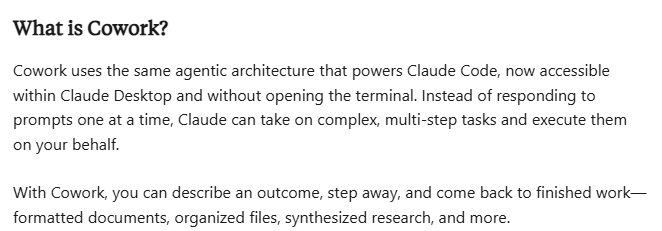
Hey, look, precisely the thing that we wanted! (Early impressions from Simon here.)
In a move, Anthropic has released a powerful general agent that can execute work for a far greater number of users than Claude Code could. What software developers loved for their own use has now been unshackled. The question before the market now is how good is Cowork?
We won’t know for a little bit. It’s currently only available to Claude subscribers of the most expensive plan ($200/month) who use the desktop Claude app for Mac. That’s a fraction of a fraction of the larger Claude userbase. But if you are building something that still needs warning labels, perhaps a little caution is warranted:

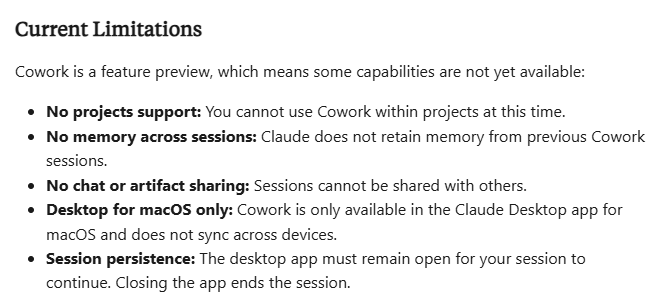
Anthropic building a general-purpose agent brings us one step closer to the future in which we all have a personal, powerful AI assistant that persists across digital surfaces and perhaps even our physical lives. But for that to work, it will need memory that is infinite in capacity and instant in recall. As the company notes, Cowork isn’t there yet:
No matter. Progress is progress, and I’ll take it.
Don’t expect to use Cowork soon, however. Anthropic warns that the service is very compute-heavy (“Cowork consumes more of your usage allocation than chatting with Claude”), and thus even its most expensive subscription plans may run out of capacity (“If you're on a Max plan and find yourself hitting usage limits frequently when using the Cowork research preview…”)
This means that we’ll be able to track how quickly Anthropic brings new compute online by how quickly they can onboard more Cowork users (by expanding the circle of users eligible for access), and making it easier to use (by raising compute limits on a per-account basis). Given the general arc of AI progress and how much compute Anthropic has in the pipeline, I presume that we’re but a few quarters away from being able to play with it ourselves.
At which point the product will be greatly improved. You love to see it.
And on that high note, may the people of Iran be free, may Ukraine kick out the invaders, may the United States continue to stand up for individual rights, and may we all have time with our loved ones. Hugs, and see you here in a bit with a picture of the latest Wagner-Wilhelm.