
Investors bet on Waymo's acceleration
More cars + new markets + international scaling = a very quickly growing business
Welcome to Cautious Optimism, a newsletter on tech, business and power.
📈 Trending Up: American control of Venezuelan oil exports … board drama at Monzo … chip IPOs in China … Sure, Jan … prediction markets … oof … Indian exports … Slate.Auto …
Startup of the Day: Cyera, now valued at $9 billion thanks to a $400 million investment led by Blackstone. (I interviewed the company twice last year.)
📉 Trending Down: The joys of pushing media around … kids’ health … Paramount’s WBD bid … US-EU relations, viz tech regulation … FSD marketing …
Things That Matter
Another $10B for OpenAI: CNBC and The Information report that OpenAI is talking to Amazon to raise as much as $10 billion and secure a partnership to use the e-commerce giant’s chips. It’s not surprising to see OpenAI trying to raise more, but news that Amazon may be the next wallet that it taps is almost so.
After all, Amazon has long had a deep partnership with Anthropic, OpenAI’s arch rival. But with Microsoft (a critical OpenAI backer and material shareholder) investing in Anthropic (alongside Nvidia, recall), perhaps it makes sense. Don’t forget that OpenAI also uses Google’s cloud and TPU chips, as does Anthropic.
Confused? Major AI labs are diversifying their cloud computing partner bets to include all major players, and they are landing deals to ensure they are up to speed on non-Nvidia hardware. Compute and chip diversification for the AI labs, and model diversification for the major cloud players.
Spread risk is less acute; but if every company spreading risk does so by smearing it across the other players in their market, are we de-risking at all?
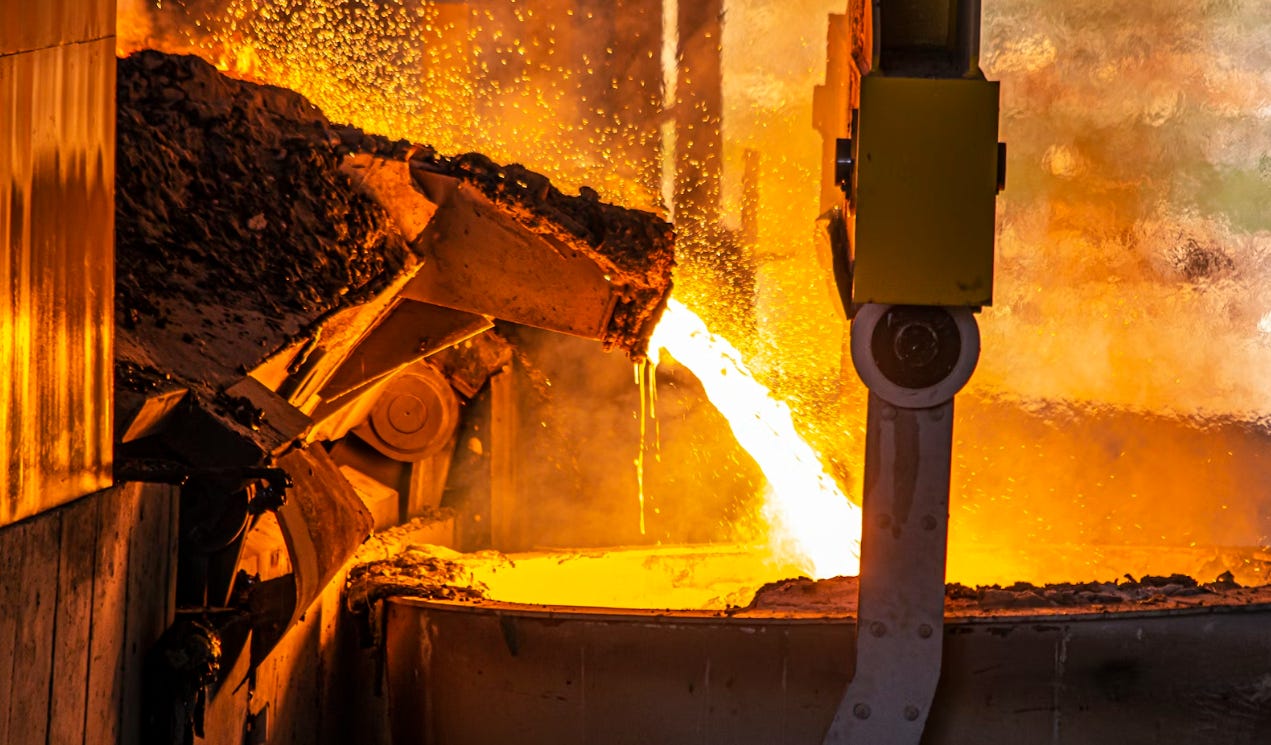
Korea Zinc, and the means of production: Earlier this week, Korea Zinc said it would build a mineral smelter in Tennessee in partnership with the United States government and unnamed private investors. The money picture is as follows:
Investment required: $7.4 billion through the completion of the “650,000 m² smelting facility in Tennessee.” (An existing smelter owned by Nyrstar will be purchased, torn down, and replaced with the new, larger installation.)
The United States’ involvement: Korea Zinc will sell $1.9 billion worth of shares to a new JV that the US will control alongside domestic private investors. Reuters reports that the DoD will hold a 40% stake in the JV, while Korea Zinc will own “less than 10%.”
But wait, there’s more: Reuters also writes that the US “and financial institutions” will supply $4.7 billion worth of loans for the project, alongside $210 million in “subsidies from the U.S. Commerce Department under the CHIPS and Science Act.”
Even more: Korea Zinc told investors it is also “actively review[ing]” other “support measures at the U.S. federal and state government levels.”
Basically, the United States government and select private parties are putting up the capital needed for a South Korean industrial giant to build a domestic smelting facility, and are keeping the lion’s share of the equity and control in the process. (Some Korea Zinc shareholders are upset at the terms.)
Put another way, the US is using public funds to induce the creation of domestic industry that will be collectively owned. Viva la state capitalism, or, as it seems here, viva la socialism? (Commanding heights and all that.)
Peec rising: There are a number of startups building tools to help brands track their prominence in gen AI search. I’m most familiar with Profound (I interviewed the startup in early 2025) and AthenaHQ (whom I spoke to in May), but we need to keep an eye on Peec, a rival based in Berlin that is growing quickly.
Per Seb Johnson of the Scaling Europe newsletter, Peec has “surpassed $5m ARR less than a year after being founded.” Now in these days of the AI era, we often hear of quicker growth rates, but for a pure-play SaaS company, Peec’s growth is impressive.
The lesson here is that the AI wave is big enough to create many new startup categories, each capable of supporting the growth of several startups.
Sure, the GEO space, as it is sometimes called, will eventually see consolidation, but I doubt it will collapse down to a single point of light. If Peec wants to be one of the last startups standing, it will need to triple in size next year.
The deluge of new AI models: Black Forest Labs dropped FLUX.2 [max] this week, which the image generation startup calls its “highest quality model to date.” Tencent pledged to open-source its new model, HY World 1.5 (WorldPlay), which it says is a “world model with real-time interaction and long-term memory.” And Decart released Lucy Motion, an “image-to-video” model that gives users “precise control over motion.”
Not to be outdone, OpenAI released GPT Image 1.5, an upgrade to its existing image generation tech inside ChatGPT. Also available via the OpenAI API, the model took the top spot on the pertinent LMArena leaderboard. Oh, and Nvidia introduced the latest iteration in its Nemotron family of models.
Finally, Xiaomi released MiMo-V2-Flash, adding another open model to our collective arsenal. For fun, here’s how the MiMo team describes it:
MiMo-V2-Flash is a Mixture-of-Experts model with 309B total parameters and 15B active parameters, adopting a hybrid attention architecture that interleaves sliding-window and full attention, using an aggressive 128-token sliding window and a 5:1 hybrid ratio. With such a lightweight model architecture, we deliver superior intelligence.
I understand a full 75% of that. That’s probably not enough.
Waymo accelerates
Yesterday, we ran did simple math on Waymo’s scale, finding that at its present pace of 450,000 weekly paid rides, the Alphabet division is likely generating run-rate revenue north of $300 million. The golden question was: “Could Waymo reach $1 billion in revenue next year?”
Our spitballing was well-timed: Bloomberg reports that Waymo is in talks to raise “more than $15 billion at a valuation near $100 billion, in a financing round led by its parent company.” The company was last valued at around $45 billion in October 2024, when it last raised funds.
Waymo has raised capital from Alphabet, yes, but also from Mubadala, Solver Lake, Fidelity, T. Rowe Price, Tamasek, Tiger, a16z and others.
Using normal valuation math, Waymo’s potential new valuation is batshit — 300x current run-rate revenues is silly AI startup territory. So why are investors seemingly willing to pay so much for Alphabet’s self-driving project (and why would I join the round if invited)? Simple: investors expect Waymo to accelerate, not merely maintain its current pace of expansion.
Altimeter investor Freda Duan — who arrived at a run-rate estimate of $350 million to $400 million, similar to our own $350 million figure — ran an analysis and found that if Waymo scales from the roughly 3,000 cars it currently fields to 7,000-10,000 in the next four to six quarters, its “GMV would scale to ~$1–2bn run-rate.”
Why Duan uses GMV when Waymo doesn’t share ride revenue with driver-partners is not clear to me, so I used her language directly.
I think Waymo can manage that expansion for two reasons. First, the startup can add supply to its existing markets and grow ride volume and revenue rather easily (presuming, as it appears, that demand for robotaxis is supply-limited today). Second, Waymo says it is “laying the early groundwork for ride-hailing operations in over 20 additional cities in 2026, including international cities like Tokyo and London.”
More cars in existing markets + new markets + international scaling = a very quickly growing business. And with Alphabet’s endless coffers for a backbone, the self-driving outfit will be able to afford the hardware it needs.
The biggest obstacle to Waymo? Moving too fast and breaking rider and government trust. The second largest obstacle? Rising competition from companies like Zoox and Tesla (United States) and Chinese companies abroad.
You could argue that Waymo needs to accelerate its international expansion to maintain market leadership. More capital will help with that.
As someone who finds driving tedious and other humans drivers insufficiently sentient, I remain an unabashed self-driving bull. Come to Providence, Waymo.